

Product Description
A masterpiece of model-making:
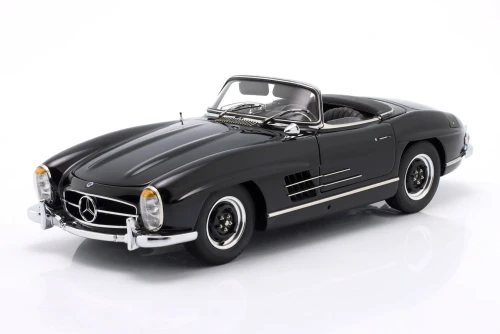
Mercedes-Benz 300 SL Roadster (W198 II) 1957–1963 1:18 CMC
M-285
Model Details:
- Hand-assembled precision metal model with left-hand drive, consisting of 1,067 parts
- A folding fabric convertible top, allowing the model to be displayed as either an open-top or closed convertible
- Front-hinged hood with support rod
- Trunk lid, trunk with spare tire
- Perfectly designed steel-rim wheels, painted to match the car’s color, with removable hubcaps, also painted to match the car’s color
- Highly detailed 6-cylinder inline engine with auxiliary units and wiring harness
- Authentic interior with steering wheel, pedals, and retrofitted seat belts
- Leather-upholstered seats
- Accurately reproduced dashboard with all gauges, switches, and an ashtray that can be opened
- Exact replica of the underbody, with perfect front and rear suspension
- Hinged soft-top storage compartment lid
- Hinged door handles
- Retractable antenna
- Fuel filler door that opens
The 300 SL Roadster was unveiled in March 1957 at the Geneva Motor Show as the successor to the Gullwing, which had been introduced back in 1954, and was actively sought after by the car’s then-importer in America, Maximilian Hoffmann.
Externally, the car differs from the coupe at the front due to its different headlights and, of course, its fabric convertible top.
However, to allow for comfortable entry even with the top down and to equip the car with doors hinged conventionally on the A-pillar, the tubular space frame had to be fundamentally redesigned. The “normal” entry also eliminated the need for the coupé’s folding steering wheel.
The suspension was also improved and featured a single-joint swing axle, which provided significantly greater driving instability than the coupé’s sometimes treacherous double-joint swing axle.
Furthermore, starting in 1961, the Roadster became the first Mercedes-Benz passenger car to be equipped with disc brakes on all four wheels.
215 PS from the three-liter direct-injection six-cylinder engine and a top speed of 250 km/h were a real statement at the time and were enough to secure its place in history as one of the most powerful supercars of its era.
During its production run from 1957 to 1963, 1,858 units of the open-top, exceptionally elegant, and elongated 300 SL were built—a model that, incidentally, laid the foundation for the SL legend that continues to this day.